Warning: This is a major spoiler zone for the book. We strongly encourage you to finish reading the book first, as it is a once-in-a-lifetime experience.
One would think this book, Anxious People by Fredrick Backman, is about anxiety and how a story unfolds as the main character tackles it.
No.
We would all agree that, despite this being a light read, some of the harder truths of life were wrapped in dry humour in this novel. The plot would sound almost nonsensical in summary but as we delved deeper into the discussion, we found the book to be quite insightful beneath its facade of idiocy.
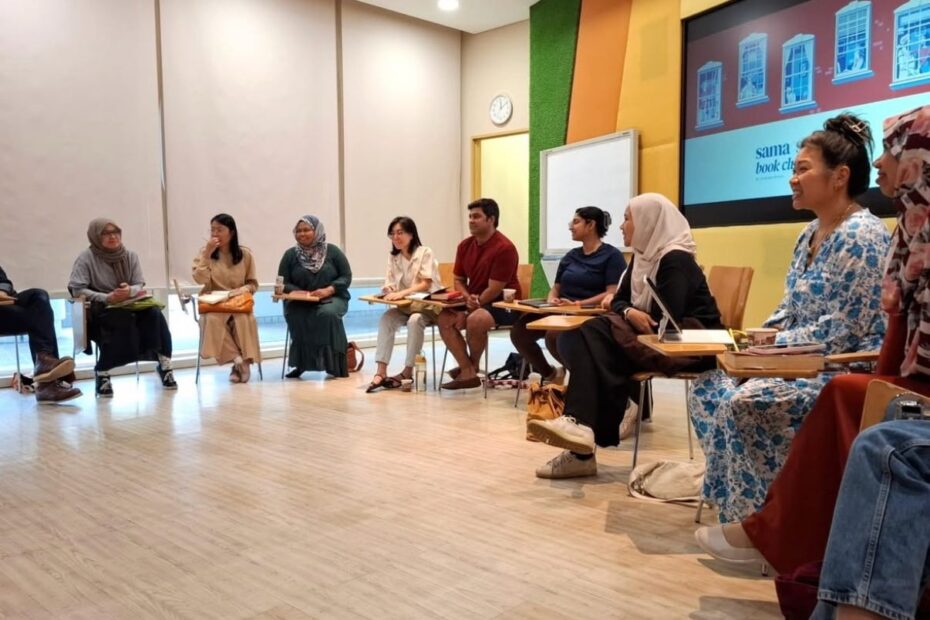
The Sama-Sama Book Club explored this book in a session held on Sunday, 25 January 2026, at the Central Public Library, Victoria Street, Singapore.
Humour and idiocy
“… soif the grass looks greener on the other side of the fence, that’s probably because it’s full of shit.” – Page 67
The dry humour in this book is what stands out most and gives it a unique style of writing. It seems to be trying too hard to be funny. Some of us think it reflects the monologue of a very anxious person, typically using humour as a coping mechanism to mask anxiety. While some of us think it can be quirky at times, and others think it can be sarcastic.
There are also different types of humour shown through characters, for example, Ro, who had a ditsy sort of humour. Through the variety of characters and relationships, it has shown us the different ways we relate to humour. Hence, each of us would resonate differently with the characters and their sense of humour.
“You don’t think enough. Have you thought about that?” – Page 49
The discussion did bring up that the characters are made to look like idiots, which serves as a veneer of idiocracy in the story. However, between the lines, the book does bring out the deeper idiocracy of life. For example, the idiocracy of bureaucracy and the idiocy of banks — loaning to the rich because they could pay, instead of loaning to those who need it.
Breaking down the biases
There are a few descriptions of the setting and characters; some are intentionally left ambiguous. The consensus was that the author has done a brilliant job because, as some plot twists reveal more details, they push us to rethink our stereotypes and biases.
One major talking point was the revelation of the bank robber’s gender. Most of us had assumed that when a couple divorces, the father would leave the house and the mother would get custody of the children. Even with the affair with the boss, we would assume the boss is male. We are conditioned to fill in the blanks with our biases, but this was a good reminder to keep biases in check.
Relationships explored
The interactions of the characters reveal the different types of relationships we will experience in life, in some way or another. Here are some of the most memorable ones mentioned during the session:
Jim and Jack
This father-and-son duo was said to be the heart of the book, in part because their relationship was seen throughout the story. Their interactions revealed many tender and beautiful moments and captured the nuances of the relationship between fathers and sons. The dynamics of their relationship with the wife and the mother were so loving and delicate.
Bank robber and her mum
One of the most important lessons picked up is that you could never really hate your mum. It was a sweet moment to see the bank robber’s relationship with her mum transferred to her and her daughters.
Anna-Lena and Roger
This turned out to be one of the biggest stereotypes. Anna-Lena, who seems to be the housewife, turns out to be the big shot in life, and she spends her retirement trying to make it up to Roger. The amazing interaction between them showed us how people show respect for each other in a relationship, and how a woman can bloom when loved properly. It also challenged us in the idea of how men would feel inferior to women, especially with societal expectations of men needing to be the breadwinners.
Zara and Lennart
Zara and Lennart were the unexpected romance that popped up in the book. We just loved how Zara slowly learned to be vulnerable, and Lennart could hold space and allow her to be.
An Estelle moment
If you could pass one book to your crush, which book would it be? This might be one of the hardest questions to answer.
“…inthe lift he gave her a very thick book, written by a man. He had underlined one sentence….Estelle gave him a book in exchange, one written by a woman, so it didn’t need hundreds of pages to say things.” – Page 354
We started with safe options: books we love or that move us the most. It then raises the dilemma of whether we should pass the book we love to our crush, which is also most painful.
One reader suggested giving the most hated book, but not revealing any thoughts on it. It can be an exercise to test if your crush can be open and honest about differing opinions, or, in other words, hate that book.
This was a fun moment during the discussion when we could see how people could connect deeply through books.
And perhaps, we should bring the romance back through books too.
At the end of the day
“You don’t fall in love with a gender, Anna-Lena. You fall in love with an idiot.” – page 208
In the end, we are all anxious people dealing with the anxieties of life, albeit in varying degrees. We acknowledge that we are all idiots sometimes, which is, ironically, the same reason we are lovable.
Hence, be kind to one another, and don’t forget: this includes ourselves as well.
Quick Links
Credits for this article:
Written by Hew Chin Yi
Edited by Nurul ‘Ain Razali